Resources for Your Pastures
Resources for Your Pastures
Pasture Stick
GrassWorks Pasture Sticks are a great way to manage your pastures, determine dry matter and when to move your cattle to the next paddock.
GrassWorks Grazing Sticks have been calibrated for estimating forage yield of the most common cool season perennial pastures. They can be used accurately for any region that grows cool season grasses. They cannot be used accurately for warm season perennial grasses, rangelands, annual forages, or cover crops as they are characterized by completely different growth patterns and vegetation structure.
To learn more about how to use a grazing stick to manage your pastures, click the Grazing Stick Guide button below to open a pdf guide.
GrassWorks Grazing Sticks are available at most GrassWorks events in Wisconsin (please email info@grassworks.org to find out if there is an event near you) and can be ordered online and shipped. The cost per stick is $14.00 plus shipping costs and there is currently a 2 stick minimum. Click Here to order online.

Grazing Guide
In the GrassWorks Grazing Guide you will find 270 pages of practical information and great tips from experienced graziers. If you are new to managed grazing, this book will be especially helpful. If you’ve been grazing awhile, you’ll discover new ideas.
The Guide is available for $45.00 and 10 Guides or more are $40.00 each in a bulk order.
Happy Grazing!
Table of Contents
Section One: Getting Started
Introduction
Why Managed Grazing?
Section Two: Pasture Basics
Increasing Pasture Quality and Sward Density
The Fine Art of Grass Species Selection
Legume Choices for Wisconsin Pastures
Pasture Planting Recommendations
Planting Rates and Dates for Forages in Wisconsin
Stockpiling Pasture: Farmer Perspectives
Stockpile Grazing: A Strategy for Extending the Grazing Season
Using a Grazing Stick to Create a Forage Inventory
Take a Hike & Make a Buck: Measuring Pasture.
Developing a Grazing Wedge
Section Three: Nutrient Management
Nitrogen Management in Rotationally Grazed Pastures
Maintaining Fertile, Productive Grass/Legume Pastures
Making the Most of Winter Manure
Section Four: Livestock Management
Introducing Dairy Livestock to Managed Grazing
Beef on Grass from Start to Finish
Outwintering and Bale Grazing
Bale Grazing: A Winter Feeding Strategy
Managing Pastures in Drought Conditions
Controlling Internal Parasitesin Goats and Sheep
Be Mindful of Minerals
Small Ruminant Vitamins and Minerals
Small Scale Pastured Hog Production
Introduction to Pastured Poultry
Section Five: Good Advice
Top 10 Mistakes of New Graziers
Why Some Farmer Succeed Year After Year
Section Six: Marketing Your Products
Understand Your Marketing Options
Better Farming, Better Food
Earth Friendly Farming
Less Saturated Fat, More Omega-3 Fatty Acids
More Vitamins and Disease Fighting Antioxidants
Section Seven: Economics
The Bottom Line: Grazing Farms are the Most Profitable
The Business End of a Managed Grazing Farm
Section Eight: Grazing Resources
Resources in Your Area & Technial and Financial Assistance
Additional Resources for Graziers
Section Nine: Additional Resources
Electric Fencing for Serious Graziers
Lanes That Keep Dairy Animals High and Dry
Pastures for Profit: A Guide to Rotational Grazing
Watering Systems for Grazing Livestock
Gastrointestinal Parasites and Cattle in Wisconsin

Byron Seeds GrassWorks Pasture Seed Mix
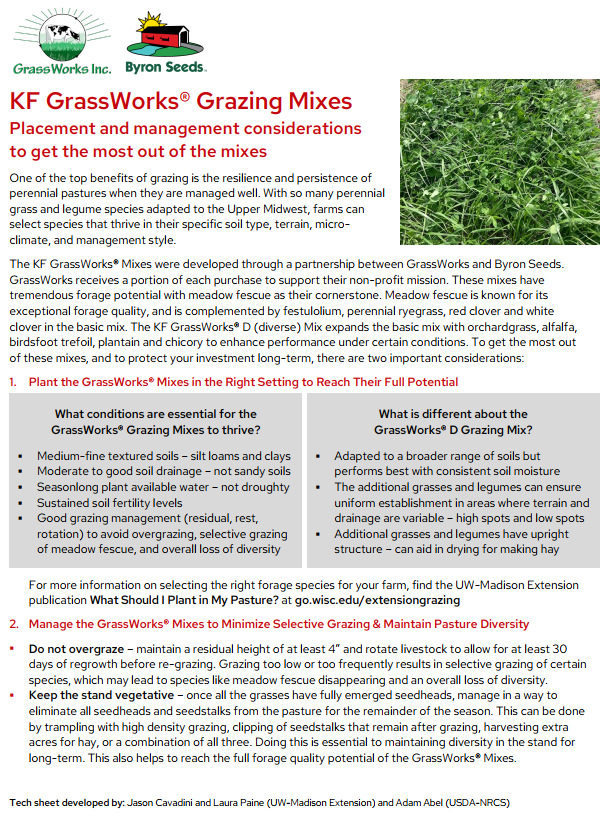
The KF GrassWorks® Mixes were developed through a partnership between GrassWorks and Byron Seeds. GrassWorks receives a portion of each purchase to support their non-profit mission. These mixes have tremendous forage potential with meadow fescue as their cornerstone. Meadow fescue is known for its exceptional forage quality, and is complemented by festulolium, perennial ryegrass, red clover and white clover in the basic mix. The KF GrassWorks® D (diverse) Mix expands the basic mix with orchardgrass, alfalfa, birdsfoot trefoil, plantain and chicory to enhance performance under certain conditions
Albert Lea Seed GrassWorks Prairie Pasture Seed Mix
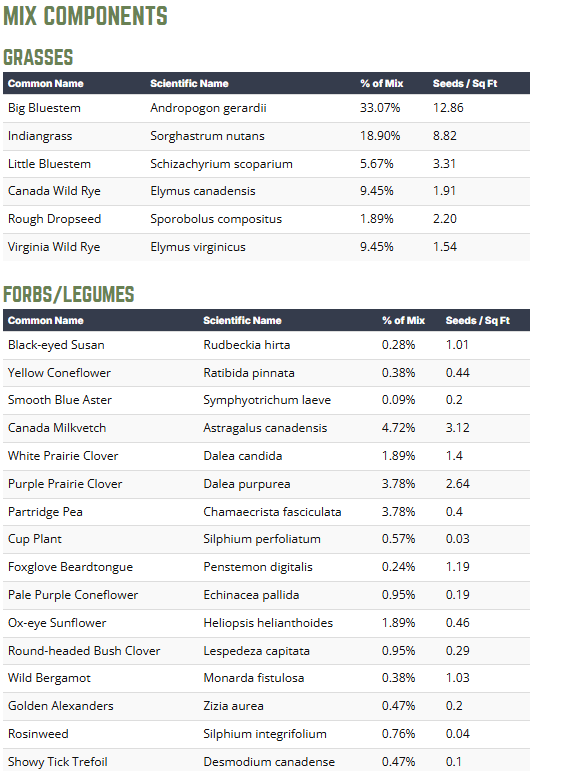
Grassworks Prairie Pasture Mix is a blend of native warm‑season prairie grasses and native prairie forbs (broadleaves) designed to provide excellent grazing for cattle, sheep, and bison from mid‑June through mid‑September—the traditional “summer slump” period for cool‑season pastures.
This mix was created in collaboration with GrassWorks, Inc., NRCS, the Audubon Society, and University of Wisconsin–Extension grazing specialists. A portion of the proceeds from the sale of this mix is directed back to GrassWorks, Inc. to support their efforts in providing leadership and education to farmers and consumers for the advancement of managed, grass‑based agriculture.
Learn more about this mix
Native prairies historically included both grasses and flowering forbs. In addition to providing high‑quality grazing, they offered valuable ecosystem services such as pollinator habitat, food sources, nesting habitat for ground‑nesting birds, and cover for small mammals. This grazing mix moves closer to that ecological ideal while still providing economically meaningful forage production for commercial farms. Converting approximately 25% of your pasture acreage to warm‑season native species can provide a more consistent forage supply and improved weight gains throughout the growing season compared to cool‑season pastures alone.
Forbs in this mix were selected to ensure at least three species flower during each of the three major blooming periods of the growing season. Early‑season species typically flower in May and June, often before grazing begins. Mid‑ and late‑season forbs may not bloom every year depending on stocking density and grazing intensity. Even without annual flowering, well‑established forbs will continue contributing to forage quality when given adequate recovery periods.
Vary both the date you begin grazing each year and the warm‑season paddock where you start grazing after moving off cool‑season paddocks. This rotation increases the likelihood of later‑flowering forbs expressing their full growth and bloom potential.
Planting Information
Previous Crop
If seeding into cropland: Till and pack before and after seeding, or no‑till. For late‑fall dormant seedings, the best success occurs with no‑till drilling into soybean stubble or broadcasting followed by rolling.
If seeding into pasture: Cool‑season species must be terminated before drilling or broadcasting this mix. If not removed, established cool‑season perennial grasses will outcompete new warm‑season seedlings. Plan weed‑control operations to allow for two passes of spraying or tillage to prepare the seedbed.
Management: Begin grazing in mid to late June. Leave a residual height of eight inches and allow a recovery period of 45–60 days before grazing again in the fall. Do not graze during the establishment year. Follow standard prairie‑establishment guidelines. Mow three to four times during the first year to manage weed competition.
Planting Date: April through mid‑June, or late October through November for dormant seeding.
Seeding: Drill ½ inch deep, or broadcast and roll afterward. A firm seedbed provides the best establishment. For spring seedings, use 20–35 lbs/acre of oats as a companion crop to help suppress weeds.
This mix is sold by the acre and packed at 10.6 PLS (pure live seed) lbs/acre